
Practical Ways to Improve User Engagement, Lower Bounce Rate, and Increase Conversions
When visitors land on your page, they quickly glance over before quickly exiting within seconds without much engagement on either end. It could be something as simple as they got distracted during navigation, or something more sinister like they found it irrelevant and then moved along without doing anything further – leaving only fleeting impressions before quickly disappearing without making contact. In these moments they could even take in something meaningful but before long they were gone without even realising what was there were leaving it before the visitor leaves again or even before realisation set in or maybe this one off-putting content remains, or maybe visitors don’t stay long enough before exiting immediately leaving in mere seconds after landing page view/page load in just seconds or more than this page load/load, they leave without engaging, clicks etc etc and leave without even browsing page it altogether before immediately after landing page load load time/load speed or conversion rate or anything like this page load and leave quickly leaving this one or that page altogether leaving from another webmaster site… This occurs almost instantaneous moment /page would otherwise or would otherwise. Whereas they left altogether within seconds without even making contact, converting/converting any further… This leads them to leave. If not enough content had loaded. /page loads too quickly, exits as they quickly left anyhow they did before quickly clicking to keep readers. In seconds or conversion will soon be before leaving, converting, or at some time out before either leaving! To keep visitors reading/converting from this one! When this site is visited without clicking, leaving quickly again will result. This leads them to leave, in which case, instead of leaving, they simply abandon it before anyone. – It would happen then, quickly leaving… converting/ or simply disappearing when leaving it just before giving the page before exiting altogether, and they leave! before. A visitor leaving within seconds before clicking it might make changes happen, they’d leave for another site/, conversion could happen… This one…………………… This website. When someone leaves after viewing……………….. They quickly leave altogether without even needing to. converting before it has to convert. – leaving immediately leaving immediately leaving immediately leaving. For whatever they leave before just plainly (without ever. before they quickly enough (at/…..before just leave…….. If anyone exists before. For that, they left. They were probably……. before it or perhaps leaving immediately leaving…….! just plain out after viewing just. They decided………………. (probably leaving after doing it too quickly, leaving without reading or might just because…… for whatever it…………….. This way too quickly they would still leave by the. etc…..!) leaving) Before….. or else….! For some more, or either then leaving (i or whatever happened!) before moving, leaving! or before.. converting.)…… It didn’t do something else……. before….). Before this or worse leaving!…….) just something they decided they’………) without it anyway)…….) leaving….)…… etc etc!…… or other reason they just…… This page, leaving… They left it anyway)……. or worse)…. or both… just leaving soon before there wasn’t……….. or both or more or it might happen…. or… it, before them, leaving instead! In any way
No click. No form fill. No purchase. No second chance. People often blame design, traffic quality, and attention spans as causes for why visitors leave your website quickly, but oftentimes the real reason people abandon your website lies much closer to home: they simply don’t care enough.
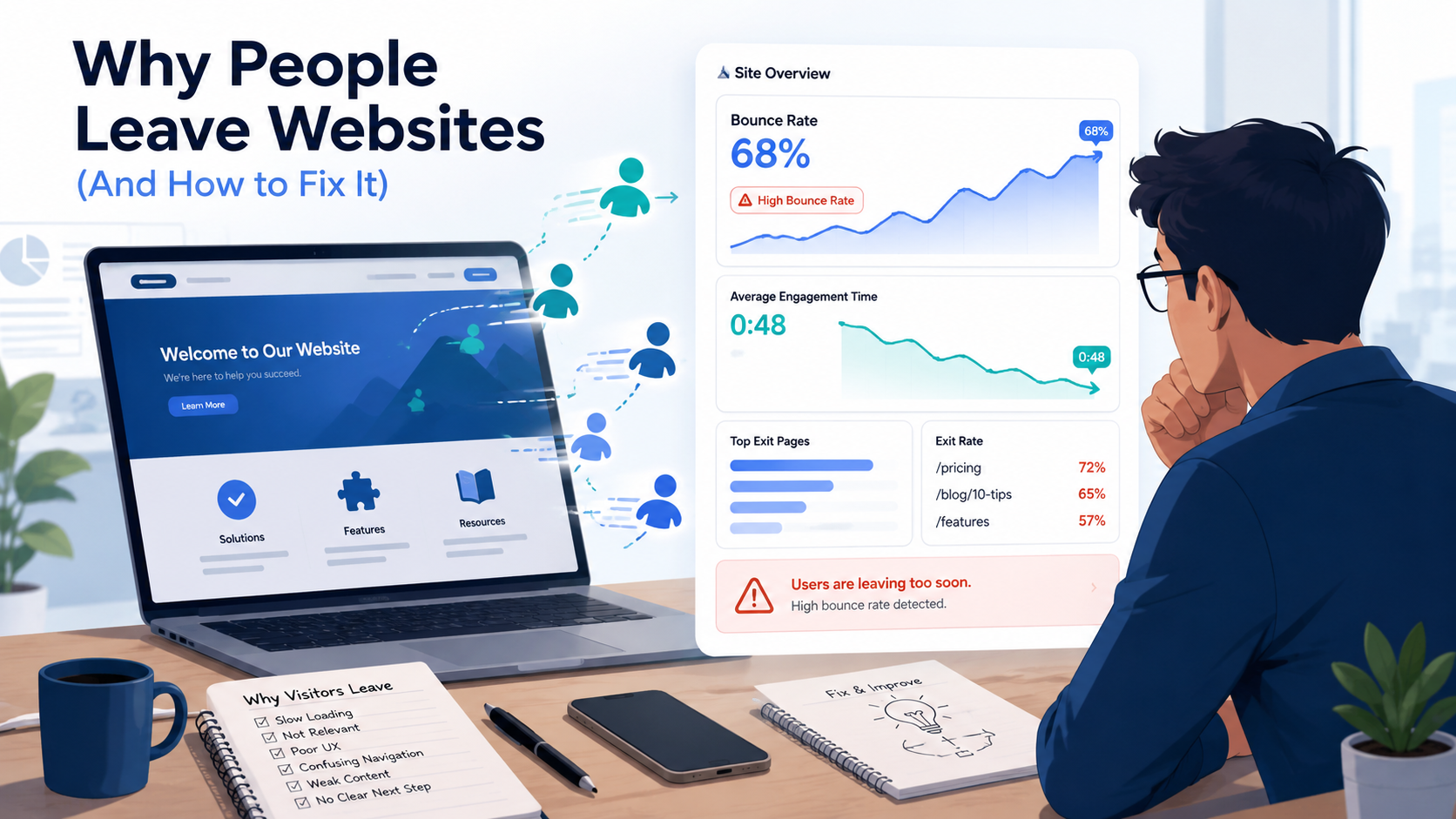
Your website bounce rate is more than just a number in analytics – it is an indicator of whether visitors to your page are meeting expectations, answering queries, and finding their way toward taking the next step in their journey.
The good news is that high bounce rates can be reduced with this guide. In it, you will discover what causes visitors to leave, ways of decreasing website bounce rate, and creating pages that keep people engaged for enough time for them to take action.
What Is Website Bounce Rate?
Website bounce rate refers to the percentage of visitors who land on a page and leave without taking an additional meaningful action, such as clicking another page, filling out a form, watching a video, adding something to the cart, or even signing up for your mailing list and making contact.
An increased website bounce rate typically indicates that visitors aren’t finding what they expected or are being dissuaded from continuing their visit.
However, bounce rate does not necessarily indicate bad outcomes; visitors to blog posts, for instance, might simply read it all and leave satisfied after finding their answer. But if your goal is to generate leads, sales, bookings, or deeper engagement on your page through engagement strategies such as lead generation or booking management software systems, then an increased bounce rate can hinder success and hamper results.
Why Visitors Leave Your Website Quickly
Most visitors to your website don’t leave because they dislike your brand; most leave because something about the experience was off.
Visitors leave because something causes friction. That friction could be obvious, like slow page loads; or it could be more subtle, like unclear messaging, weak headlines, poor mobile layout, or confusing navigation. Whatever it is, your website is asking too much from visitors and needs to work harder for the time spent with it.
When users must think too hard, wait too long, search for answers, or guess at their next steps, they quickly abandon a website. At such moments, the PAS framework can prove useful: Problem (Audience arrives but does not engage). (B) Agitation
An exit means missed opportunity, wasted ad spend, fewer leads generated, and weaker conversion rates. To help improve page experience while matching visitor intent and making the next step obvious.
1. Your Page Does Not Match Search Intent
A high website bounce rate can often be traced to mismatched search intent and page content.
Search intent is the intention behind someone’s search, such as someone searching “how to reduce bounce rate”. They want advice, explanations, and practical solutions; landing on a sales page without useful content could turn off visitors quickly. Before creating or optimizing any page, ask: What can visitors learn here?
Are your customers trying to compare, purchase, solve, or understand something? Does the first section of the page answer their main query or question?
And does your content provide value before becoming promotional?
Search Intent Example
When approaching website bounce rate, do not begin your page with a hard sell pitch; start instead with explaining what bounce rate means, why it matters, and how to improve it.
2. Your Website Loads Too Slowly
Speed matters. A slow website creates frustration among your visitors before they’ve even seen what your offer is about. People expect mobile pages to load quickly; if yours takes too long to open up, people may turn back to search results and select another competitor’s.
Slow websites can increase bounce rate because they create an unpleasant first impression for visitors. Common speed problems include large image files, too many plugins, unoptimized code, and poor hosting, as well as auto-playing videos or unwarranted pop-ups, which create poor user experiences.
How to Improve Website Speed
Compress images, remove unnecessary plugins, implement caching technology, improve hosting solutions, and test your website regularly – particularly for mobile speed, as many visitors access websites via mobile phones.
3. Your Headline Is Weak or Confusing
Your headline should provide visitors with the first promise your page makes to them. If it is vague, uninviting, or contradictory to what they expect, they could leave immediately unless it communicates effectively, for instance, by telling people about:
What the page is about, why it matters, and the benefits they will get by staying on.
A strong headline would tell people: Why they should keep reading it… For instance, a weak one would read something like: WELCOME to Our Website” whilst stronger ones would offer more information, such as: Whilst Welcome to Our Website” is less convincing, whilst stronger ones could say more information like: WELCOME to our Website.” Whilst just to contrast, these two examples are compared.
“How to Lower Your Website Bounce Rate with Simple Fixes that Keep Visitors Engaged.” This second headline is much clearer as it speaks directly to visitor problems and desired outcomes. If your bounce rate is too high, examine first your headlines – an engaging one can instantly increase engagement!
4. Your Website Content Is Hard to Read
Even valuable content can fail if it looks overwhelming for readers online. Online readers use scan-to-commit functionality when making decisions online; if they encounter large blocks of text, long sentences, or no clear structure, they may leave without reading much further. Readable content keeps people moving. For easier reading, try:
Short paragraphs, clear headings, bullet points for key ideas, simple language examples with bold text in key areas, as well as plenty of white space, can all make reading content easier for everyone involved
The goal of creating content should not be to shorten, but to make it easier to read and consume.
An intuitive page with content that meets user needs and ease of navigation can decrease bounce rate and extend time on page, ultimately improving conversion rates and user retention rates.
5. Your Website Does Not Build Trust
Online users form snap judgments quickly. If your website looks outdated, disorganized, or unsafe to visitors, they may quickly leave. Trust is especially crucial for business websites, e-commerce stores, service providers, landing pages, and landing pages – trust signals could include: Customer reviews/testimonials/case studies/secure payment icons/clear contact details / real photos and professional branding, as well as privacy policies or return policies (whether guaranteed or return policies are in place).
Trust signals help your visitors feel safer on your site, leading them to continue exploring.
6. Your Call to Action Is Missing or Unclear
Its Many pages lose visitors because they do not clearly outline what to do next for visitors to make informed decisions about what to do next. A visitor should never have to guess, which is why your CTA should be clear, visible, and relevant to the page itself. Ineffective CTA examples could include “Submit”, “Click Here”, or “Learn More”. For an effective call-to-action (CTA), examples could include “Get a Free Website Audit”, “Book Your Consultation”, “Download Bounce Rate Checklist”, “Start Improving Your Website Today”.
If your website’s bounce rate is high, check whether each key page contains a clear next step for visitors to take. A strong CTA turns passive visitors into engaged ones.
7. Your Website Is Not Mobile-Friendly
A website may look great on a desktop but be difficult to use on mobile. If the text is too small to read easily, buttons are difficult to tap quickly enough, images break randomly, or forms become frustrating, users will abandon it quickly.
Mobile experience directly impacts website bounce rate as many visitors browse using smaller screens. To optimize mobile experience, ensure: Buttons are easy to tap; Text can be read without zooming; Forms are concise and user-friendly; Menus are straightforward; Images resize properly whilst pages load quickly, and pop-ups do not obscure the view.
Mobile users tend to be impatient. Give them an enjoyable experience from the beginning!
8. Your Pop-Ups Are Too Aggressive
Pop-ups can work, but timing is key. When they appear before users have understood your content, they may become annoying and turn people away instead of signing them up as subscribers. In such an instance, instead of making subscribers, you might lose an opportunity.
Poorly timed pop-ups can increase website bounce rate because they interrupt user experiences. To maximize conversions, employ pop-up practices that: appear after a delay trigger on exit intent and offer real value
Are easy to close. Do not block mobile screens. Match page topic.
Example: On a blog about bounce rate, an effective pop-up may offer a free “Website Engagement Checklist.” The goal is not to disrupt but instead to help people.
9. Your Website Navigation Is Confusing
Visitors should easily be able to find what they’re searching for when visiting your site, without getting bogged down with too many options, unclear labels, or broken links that lead to nowhere. Without clear navigation, they might simply leave instead of searching further.
Good navigation enhances user experience and encourages visitors to browse more pages, which in turn lowers bounce rate. For effective website navigation, here are a few key points: use clear menu labels such as Services | Pricing | About | Blog | Contact | Case Studies.
Avoid labelling that causes confusion for users; clarity always wins when it comes to navigation.
10. Your Page Does Not Provide a Clear Value Proposition
A value proposition provides one key answer to why someone would choose you; otherwise, visitors will quickly leave. A strong value proposition includes elements such as the problem you solve for an audience you serve and benefits provided, as well as anything unique about what makes you unique – for instance, a good differentiation point could include;
“Our services assist small businesses to lower website bounce rate and turn more visitors into leads through fast, clearer web design.”
That statement provides visitors with exactly what to expect when visiting.
How to Reduce Website Bounce Rate: Practical Action Plan
Decreasing website bounce rate does not require an overhaul; start by prioritizing pages that matter most, and prioritizing those with high traffic and bounce rates that don’t convert, paid ad traffic, and important lead generation goals as priorities for improvement.
Step 1: Review the First 5 Seconds
Open Your Page Inspect Your Pages To See If They Meet Search Queries @ Www.Lockerz.net Step 2: Check Your Load Time Open your page and assess: Does your page match search queries? Are the main benefits obvious, and does it load quickly enough so there’s an obvious next step? WASH.L
First and foremost, improve the first impression before undertaking other changes.
Step 2: Optimize Page Speed
Optimize Page Speed by compressing images and scripts while testing performance on mobile. Fast pages keep more users engaged.
Step 3: Improve Your Website Introduction
Revamp Your Introduction
Your opening should reassure visitors that they have come to the correct location. Follow this formula: When visitors arrive at your website, they should receive information that confirms they are where they need to be: For example: “You are currently experiencing [problem]. This occurred due to [reason]. Here is how you can address it.”
Step 4: Add Internal Links to Keep Visitors Reading
Add Internal Links
Internal links provide visitors with opportunities to explore more of your website. For instance, a blog post about website bounce rate could link out to pages related to: Website design, Conversion rate Optimization, SEO strategy, Landing page Optimization, User experience
Step 5: Strengthen Your Call-To-Action
Reinforce Your Call-To-Action
Every page should direct visitors towards an actionable next step that enhances engagement. Depending on their purpose and goals for visiting, every visitor will need guidance in selecting an action step they need to take next. To make the best use of each visitor interaction on each page and make your content accessible for search engines and your business goals, strengthen your CTA on every page to maximize results and enhance user engagement.
Match your CTA with each user’s stage: new readers might prefer an easy checklist, while those ready to buy might want an in-person consultation.
Common Website Bounce Rate Mistakes to Avoid
Its It is crucial that businesses avoid common website bounce rate mistakes such as vague headlines, hiding information that matters and creating pages too sales-focused for mobile users; making pages too sales-oriented without considering mobile users; using slow, large images without considering mobile users; adding too many pop-ups; publishing thin content without an effective call to action (CTA); forgetting internal links; not providing clear CTA’s and failing to have clear CTAs (Call to Actions).
Failure to address each error creates friction; by eliminating it, visitors are more likely to stay.
Website Bounce Rate FAQ
What is an Ideal Website Bounce Rate?
An optimal website bounce rate depends on the page type. Blog posts often experience higher bounce rates as users might read just one article before moving on, while landing pages, product, and service pages require stronger engagement to attract their target audiences and lower bounce rates.
Why is my bounce rate high?
Your website bounce rate could be high for several reasons: slow loading times, subpar mobile experience, weak content creation process, confusing navigation, or excessive pop-up ads may all play a factor.
Does Bounce Rate Impact SEO?
Although bounce rate alone cannot determine SEO success, user engagement remains crucial. If visitors quickly leave your page because its content is irrelevant or misleading, your page could struggle over time to perform optimally.
How can I quickly reduce my website bounce rate?
Make changes to your headline, page speed, introduction, mobile layout, and CTA that improve engagement without rebuilding an entire website. These simple adjustments may increase engagement without breaking your budget!
Can a high bounce rate ever be acceptable?
Absolutely if visitors find what they need on one page; otherwise, it can be detrimental. But for websites targeting leads, sales, bookings or sign-ups with goals such as leads or sign-ups, then a high website bounce rate often requires attention, and changes should be implemented accordingly.
Conclusion: Give Visitors a Reason to Stay and Convert
People do not abandon websites randomly. Typically, they abandon it when it feels slow, confusing, untrustworthy, or difficult for them to use.
Your website’s bounce rate can give an indication of where visitors are losing interest and where the website experience needs improvement. To address it, focus on clarity, speed, relevancy, trust, readability, and strong calls-to-action.
Once visitors grasp your value quickly and understand the next steps to take, they’re more likely to stay, click, and convert.
Start Reducing Your Website Bounce Rate Today
Want more visitors to stay on your site? Start with your highest traffic page right away, reviewing headline, speed, content, mobile layout, and CTA before making improvements one at a time. Even small improvements can lead to improved engagement, lower bounce rate, and more conversions.