
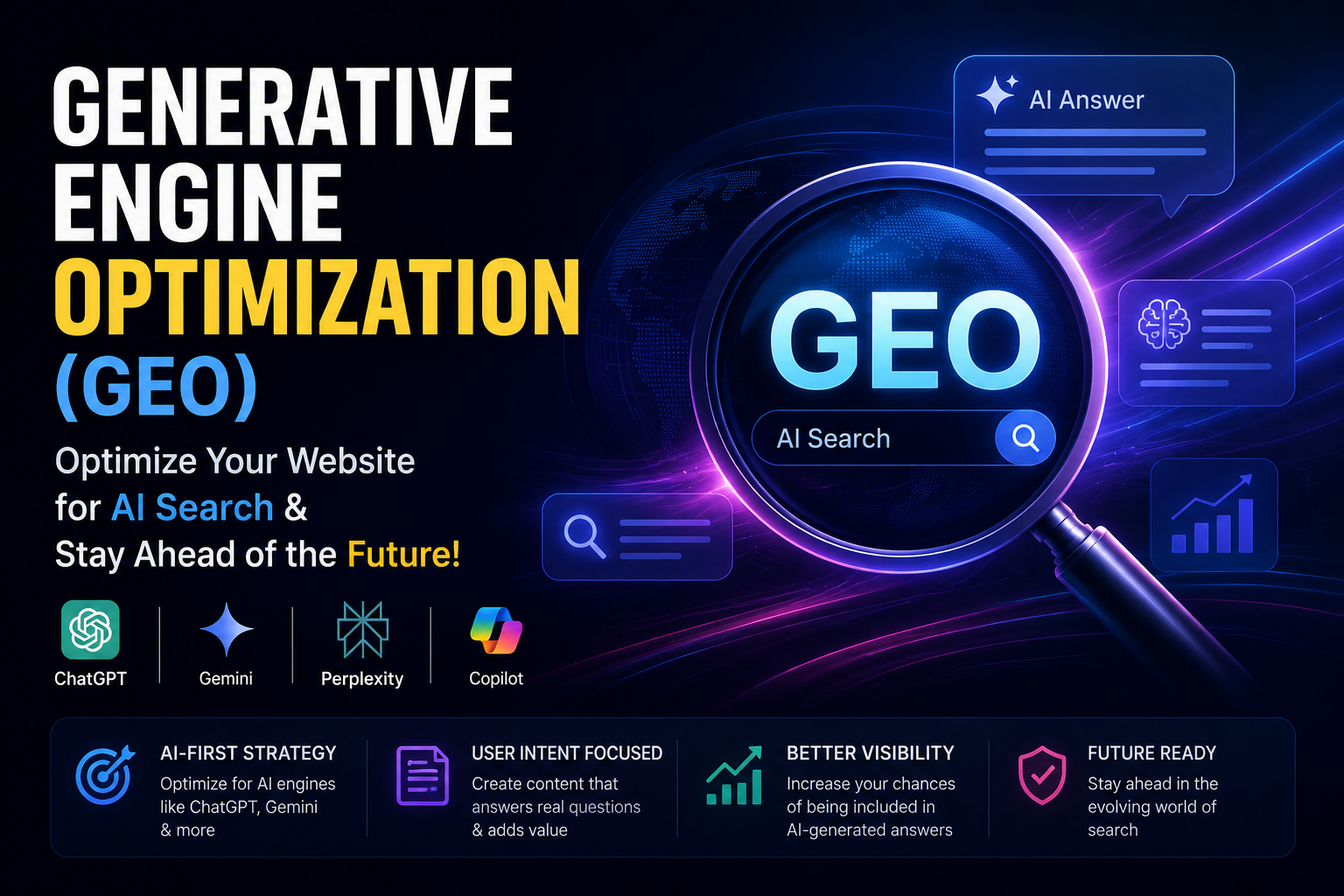
What is (GEO) and how to make your business stand out in AI searches?
Introduction:
The online world is changing rapidly. Previously, businesses focused only on ranking in Google, but now people are using AI platforms like ChatGPT, Gemini, Perplexity, and Copilot to get information. These tools answer users’ questions directly and prioritize content from websites that are trustworthy, clear, and well-organized.
That’s why SEO alone is not enough these days. Businesses now also need to focus on Generative Engine Optimization (GEO) so that their content can be part of AI’s answers.
What will you learn in this article?
- What is Generative Engine Optimization (GEO)?
- What is the difference between GEO and traditional SEO?
- How to write the best blog for GEO?
- Practical ways to create AI-friendly content
- GEO Optimized Article Checklist
What is Generative Engine Optimization (GEO)?
Generative Engine Optimization, or GEO, is a strategy by which you structure your content in a way that AI tools can easily understand, trust, and use as a reference in their answers.
While the goal of traditional SEO is to rank higher in Google, the goal of GEO is to have your website be part of the answer when a user asks an AI a question.
For example, if someone asks:
- “What is the best CRM for small businesses?”
Or
- “What is the difference between SEO and GEO?”
then the AI can use your article as a credible source.
Send feedback
How to write a blog for GEO?
1. Start with questions, not keywords
Today’s users ask complete questions. So don’t rely on keywords alone, but understand the questions your potential users are asking.
Example:
Wrong approach:
- GEO Tools
- SEO Services
Better approach:
- What are the best free GEO tools?
- Why is GEO important for small businesses?
- How to increase website visibility in AI search?
Target different types of users
Your content should be for people who:
- I want to get information.
- I want to compare different options.
- Are deciding on a purchase or service.
2. Make your article structure easy for AI
AI tools prefer well-organized content.
Best practices
- Use clear H1, H2, and H3 headings.
- Write short paragraphs.
- Include bullet points.
- Use tables and checklists.
- Include FAQs.
Examples
- Benefits of GEO
- Better visibility in AI search
- More brand authority
- Increase organic traffic
- Better user experience
3. Write in a simple and conversational style
Write as if you are answering a question from a friend.
Answer first
If the question is:
What is the difference between SEO and GEO?
Then answer clearly in the first line.
- Avoid unnecessary words
- Complex and long sentences make it difficult for both AI and the user to understand.
4. Build trust
AI prefers trustworthy websites.
How to build trust
- Include the article’s update date.
- Write the author’s name.
- Cite authoritative sources.
- Include statistics and research.
5. Build a strong technical foundation
Even the best content is only successful if the website is technically strong.
Essential steps
- Use Schema Markup.
- Improve Title Tag and Meta Description.
- Internal Linking.
- Improve website speed.
- Use a mobile-friendly design.
Difference between SEO and GEO
| SEO (Search Engine Optimization) | GEO (Generative Engine Optimization) |
| Focus on Google ranking | Focuses on being included in AI answers |
| Relies heavily on keywords | Focuses on questions and user intent |
| Optimization for search engines | Optimization for both AI and users |
| Goal is to drive clicks and website traffic | Goal is to become part of the direct AI-generated answer |
| Keyword-focused content | Conversational and answer-based content |
| Targets search engine users | Targets both AI assistants and human users |
| Success is measured by rankings and clicks | Success is measured by visibility and citations in AI responses |
GEO-Optimized Article Checklist
Before publishing your blog, check the following:
- Is the title based on a user question?
- Does the opening paragraph provide a direct answer?
- Does the article have clear headings?
- Are bullet points and short paragraphs used?
- Are FAQs included?
- Are reliable sources and references included?
- Is Schema Markup used?
- Is the website fast and mobile-friendly?
Conclusion
Artificial Intelligence has completely changed the way online searches are done. It’s no longer enough to rank in Google. If you want your business to stand out in the answers of ChatGPT, Gemini, and other AI platforms, you need to adopt a Generative Engine Optimization (GEO) strategy.
Businesses that start working on GEO today will be several steps ahead of their competitors in the future of AI search.
Do you want to know where your brand stands in AI search?
Get a GEO audit of your website today and find out how your content can be made more effective for AI.
Get a free SEO audit of your website today and improve your website’s visibility in AI search results.
👉 For more information, visit our website: [ https://sesmosmart.com/)